



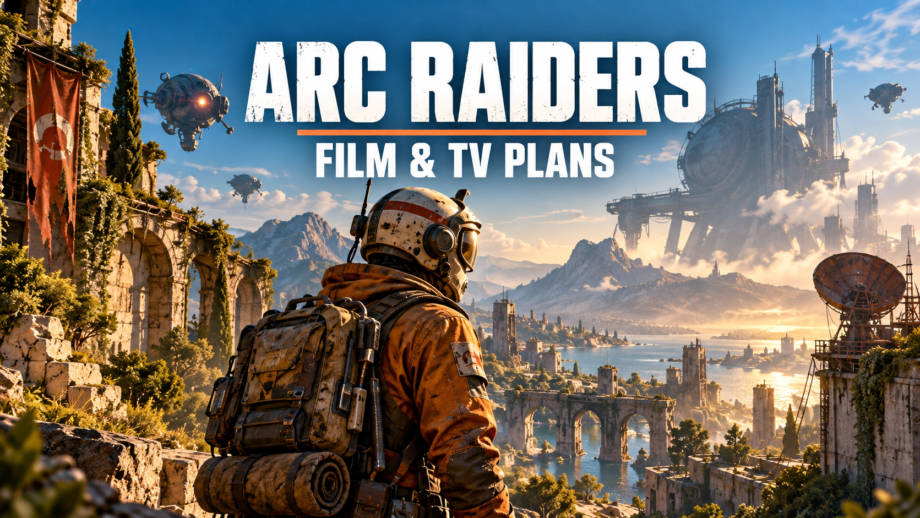
ARC Raiders is preparing to take its dangerous world beyond the extraction zone. Nexon has announced a partnership with Chernin Entertainment to develop film and television adaptations based on ARC Raiders and THE FINALS. For Embark Studios’ atmospheric survival adventure, the agreement opens an intriguing possibility: turning the tension of a desperate scavenging run into a story audiences can follow without holding a controller.
The announcement establishes the partnership, but the projects remain largely undefined publicly. Release dates have not been announced, and it is unclear how film and television formats will be divided between the two properties. Embark’s creative teams will work closely with Chernin, with studio founder Patrick Söderlund emphasizing the importance of carrying the games’ creative identity into these new formats.
That identity gives ARC Raiders plenty to work with. Its future Earth combines remnants of Italian architecture with imposing space-age infrastructure, while hostile machines dominate the surface. Players venture into that landscape to scavenge valuable resources, facing both mechanical enemies and other Raiders. The contrast between an inviting world and the danger of exploring it is central to the game’s appeal.
An effective adaptation could build suspense around the same question that drives an extraction run: how much are you willing to risk before heading home? A promising discovery can make staying longer tempting. An unexpected encounter can turn that decision into a costly mistake. Those shifting priorities offer a natural dramatic structure, with clear goals and consequences that do not require lengthy explanations.
The strongest scenes might be the quietest. Imagine a scavenger weighing whether to help a stranger while something mechanical moves beyond the cover ahead. That is an illustrative possibility, rather than an announced storyline, but it captures the kind of uncertainty the game’s premise supports. Trust, timing, and survival could carry as much weight as spectacular confrontations.
Visually, the adaptation has an opportunity to preserve the game’s contrast between beauty and danger. Sunlit ruins and industrial structures provide more personality than a uniformly gray wasteland. Giving viewers time to notice abandoned spaces, improvised equipment, and signs of everyday survival would help establish a world worth caring about before the action begins.
The challenge is translating player investment. In a game, a backpack full of hard-earned supplies immediately feels valuable because recovering it took effort. On screen, that attachment must come through characters and specific needs. A successful story would make the audience understand why a particular expedition matters—and what returning empty-handed would mean.
Embark’s involvement is encouraging because the game’s systems provide useful storytelling foundations. Still, recognizable machines and familiar locations alone will not guarantee an engaging adaptation. The characters need room to make difficult decisions, and the action needs consequences beyond setting up another impressive shot.
ARC Raiders has a strong foundation for that approach: a dangerous surface, valuable discoveries, and people willing to venture out despite the odds. The next step is turning those ingredients into a compelling screen story. For now, the partnership offers potential, with the creative details still to come.