


It may seem that retro cables should be the cheapest part of a console setup, but in recent years their price has risen dramatically, turning a simple accessory into a potential expense that can rival a quality video scaler.
Some retro cables are borderline scams
Examples of some decent quality cables.
(Image credit: Phil Hayton)
Scrolling through Amazon for a cable for a vintage console usually brings up a long list of low‑cost, no‑name options. While a few of these work adequately, many are poorly constructed and can produce weak pictures or even damage delicate hardware. My own recent test highlighted how risky a cheap purchase can be.
I needed a proper SCART cable for a Sega Dreamcast that I had lent to a friend, and the only VGA box I owned required a true SCART input. I ordered a budget cable for about £8, expecting a simple plug‑and‑play solution. When the package arrived, the cable felt almost weightless, and the plastic housing on both ends flexed too easily for a connector that should be sturdy. More concerning, the plug that mates with the console was the wrong size and lacked the correct shielding, meaning it could easily short pins or stress the socket.
Curiosity got the better of me, so I modified the connector to fit the Dreamcast without forcing it. To my surprise, the cable showed no picture on my TV, and when I opened it I discovered that half of the SCART pins were not soldered to the wires. In other words, the cable was fundamentally broken and could have ruined the console if I had forced it in.
Apologies for the low quality image – I happened to save this example of a bad SCART cable from a previous return.
(Image credit: Phil Hayton)
Such red flags are why I advise checking reviews carefully; a four‑star rating with only a handful of comments can hide serious flaws, as seen in this case where users reported only blue images, indicating missing red and green components.
Even “working” cables can cause retro gibberish
(Image credit: Phil Hayton)
Even when a cable appears to transmit a signal, poor shielding can introduce buzzing audio, wavy lines, or colour bleeding. I once used a cheap composite cable at a retro gaming event; although it carried a picture, the colours were washed out, the image trembled, and occasional static crackled through the audio. The root cause is insufficient shielding, which allows the yellow video signal to interfere with the red and white audio conductors.
Low‑quality S‑Video cables on systems like the Nintendo 64 can blend the luma (brightness) and chroma (colour) signals, resulting in muddy visuals and reduced sharpness. Unshielded cables are therefore a common source of “retro gibberish” that detracts from the authentic experience.
Why shielding matters
Analog video signals are especially vulnerable to electromagnetic interference. A well‑shielded cable keeps the video and audio lines separate, preserving colour accuracy and preventing audio hum. Unfortunately, many inexpensive cables now skip proper shielding to cut manufacturing costs, relying instead on thin aluminium tape that offers minimal protection.
High-quality cables will make your wallet cry
(Image credit: Phil Hayton)
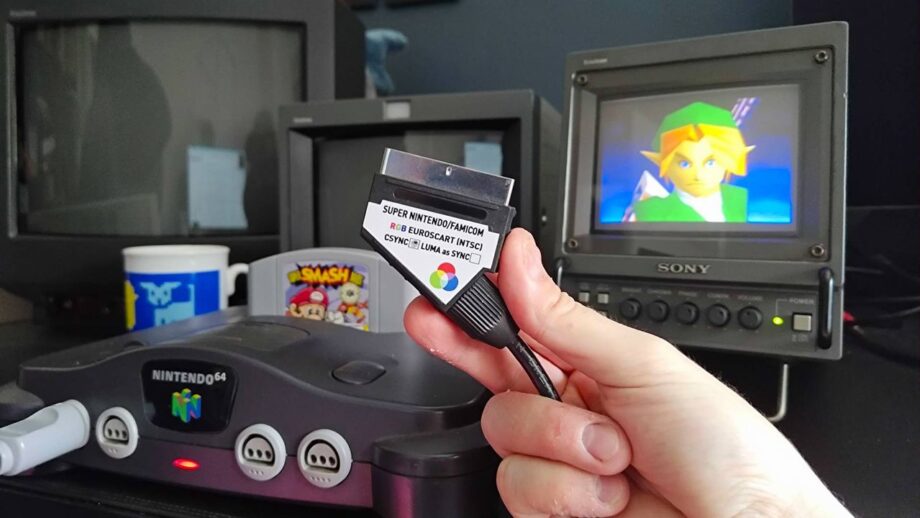
Premium cable makers such as Retro Gaming Cables have built a reputation for delivering RGB SCART solutions that faithfully reproduce colour and sync. Their “Packapunch” series, introduced in 2016, uses custom printed circuit boards and meticulous shielding, which is why a SCART SNES RGB cable now retails for about £26 ($35). While the craftsmanship is top‑tier, the price can be a barrier for hobbyists who own multiple systems.
(Image credit: Retro Gaming Cables)
If you can afford a high‑end scaler like the RetroTINK 4K ($750), investing an extra $30‑$40 in a reliable cable makes sense, but for those using more modest devices such as the OSSC or GBS Control, the added cost feels harder to justify. Other brands, including Retro‑Bit, offer a GameCube component cable for $59, and Hyperkin’s 3‑in‑1 HDTV cable for Nintendo systems costs $34.99, providing a middle ground between cheap unbranded options and high‑end enthusiast gear.
Smaller sellers can also fill the gap. Retro Computer Shack, an eBay vendor, supplies microcomputer and console cables at lower prices while maintaining decent quality. I have used their Mega Drive RGB SCART cable with a 3.5 mm audio feed for my FPGA‑based Commodore 64 Ultimate, and it has performed reliably.
Choosing the right cable ultimately depends on your budget, the console you own, and the scaler you plan to use. If you already own a quality video processor, a modestly priced original cable may be sufficient; otherwise, splurging on a well‑shielded RGB SCART or component cable can protect your hardware and improve picture quality.
Do you have a favorite retro cable brand or a hidden gem you’ve discovered locally? Share your experiences in the comments below – the community can help point others toward trustworthy options.
- HDMI Scalers on Amazon
- retro consoles on Amazon
Explore the best retro controllers for new pads that still feel authentic.