


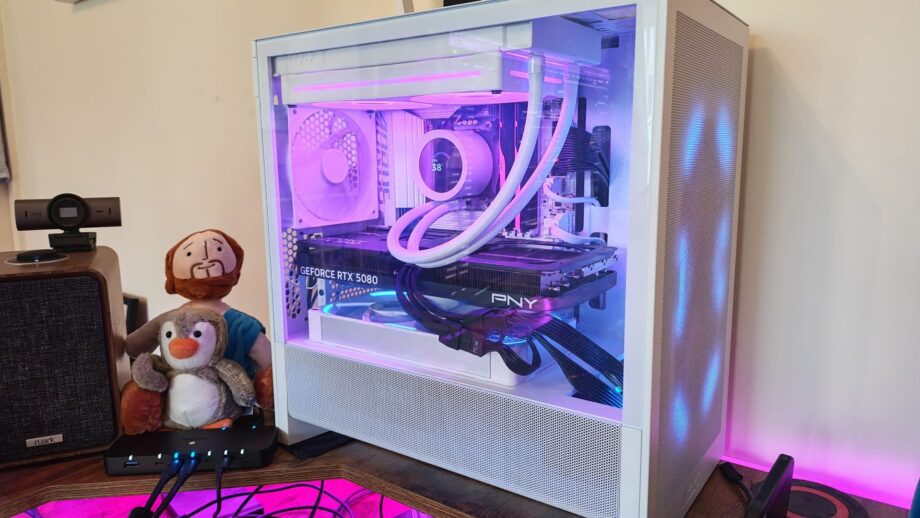
Rebuilding My PC and Solving USB Short‑Circuit Woes
At the start of summer I rebuilt my PC for the umpteenth time. My old small‑form‑factor case used an IT motherboard that limited me to Raptor Lake CPUs, which as a reviewer I wanted to replace. The new board I chose caused the system to short out whenever all my USB devices were plugged in – a mouse, keyboard, controllers, a Stream Deck+, and the Rodecaster Duo with dual USB connections.
A short could crash the PC, get stuck in a boot loop, or erase the CMOS. I wasn’t sure if it was a screw, a faulty board, or some other mistake. It turns out the problem was a specific issue with the Rodecaster Duo and a motherboard USB power‑negotiation mismatch. From the beginning, having all USB devices connected caused the trouble. I wasn’t a fan of a $149 USB hub, but I found Rode’s hub sturdy, with mounting options that suit content creators.
(Image credit: Future/Duncan Robertson)
The Rodecaster Duo has dual USB‑C outputs that can either supply power or act as a data device. When connected, it negotiates with the host to decide which mode to use, sending a 5 V output to power external devices. Some motherboards struggle with this negotiation, leading to boot failures or unexpected shutdowns.
As Isabella, a Rode customer service agent, explained: “When connected to a USB port, the interface will negotiate over USB to determine what it is connected to. This process includes sending a 5V power output with a view to powering an external device if one is connected,” she told me.
(Image credit: Future/Duncan Robertson)
Strange USB negotiations aside…
(Image credit: Future/Duncan Robertson)
A possible solution, as suggested by Isabella, is to place the Duo through a fast external USB hub. This isolates the power negotiation from the motherboard, preventing the short. Rode sent me a high‑speed hub, and connecting both USB‑C plugs of the Duo through it eliminated the shorting issue. Leaving the Duo unplugged for 24 hours also fixed its boot‑loop.
(Image credit: Future/Duncan Robertson)
The Gigabyte B860M AORUS Elite WIFI6E ICE is a solid motherboard with quick‑release M.2 catches, fault indicators, an ice‑white PCB and RGB. It supports Intel Core Ultra, Gen 5 SSDs and DDR5 RAM, and its M‑ATX size fits my case while costing $169.99 (or $169.99 at Amazon).