


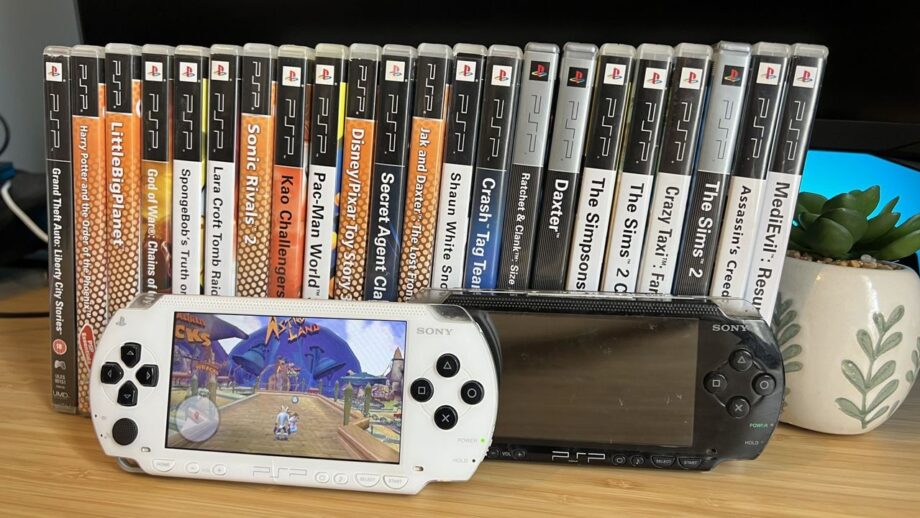
(Image credit: future)
I’m not usually a trend‑hopper, but when the physical‑media revival started to surface, I sensed a shift. With new hardware prices climbing, streaming services growing more greedy, and a lingering sense of pride in ownership waning, something had to give. The signs were clear, and I’m glad it did.
What worries me, though, is the flood of cheap plastic gadgets that could end up in landfills once the novelty fades. Could there be a device ahead of its time that satisfies the desire for tangible ownership without relying on mass‑produced factories? Might we rescue older hardware from becoming electronic waste?
Why the PSP Still Captures My Imagination
A Brief History of the PSP
The PlayStation Portable, first released in 2005 across North America and Europe, was marketed as more than a gaming handheld. Its launch promised performance that rivaled a PlayStation 2, a sleek design, and the innovative UMD (Universal Media Disc). That disc allowed the PSP to function both as a game console and a media player, keeping physical media at the heart of the experience.
In my view, the UMD deserves more credit. It enabled owners to hold entire game libraries and movie collections in their pockets, a feat that still feels impressive today. While Sony’s focus shifted toward digital distribution after 2009—evident in the all‑digital PSP Go—the legacy of the UMD endures.
According to Sony’s own specifications, the UMD held up to 1.8 GB of data, which was modest by modern standards but sufficient for the games and movies of its era. Current estimates suggest roughly 1,000 to 1,500 movies and nearly 2,000 games were released on the format.
The PSP’s Early Vision as a Smartphone
Long before the iPhone debuted in 2007, Sony envisioned the PSP as a hybrid device. The official guide book notes that in November 2003, when the prototype was shown to Western journalists, mobile‑phone functionality was listed among possible features. Speculated upgrades included a USB keyboard for productivity and a built‑in GPS (later realized in the PSP‑290 prototype).
Although the calling and messaging functions never arrived, the PSP still offered web browsing, MP3 playback, photo capture via the Go!Cam attachment, and, of course, gaming. Its emphasis on physical media set it apart from the emerging smartphone trend.
Market Availability and Pricing in 2026
Finding a working PSP‑1000 today is straightforward. On resale platforms such as eBay and Vinted, you can expect to pay between $60 and $80 (or £40‑£60) for a unit with minor cosmetic wear. If your budget reaches $100, it’s wise to include a replacement charger, battery, or memory card, as these accessories often need swapping.
How much should you pay for a PSP in 2026? In today’s market I would aim for around $60‑$80 / £40‑£60 to get a working PSP1000 with some minor cosmetic wear through sites like eBay and Vinted. You may have to buy a replacement charger, battery, or memory card at that price, but if you’re anywhere near $100, you should get them by default. Go cheaper and you can easily find replacement parts on AliExpress.
Cheaper options are plentiful; parts are widely available on AliExpress, making repairs affordable. In the UK, similar devices typically sell for £40‑£100, depending on condition and included accessories. (Image credit: future)
Why the PSP Is a Handyman’s Dream
The PSP’s design is refreshingly simple. It contains relatively few components, and most failures can be diagnosed and fixed without a soldering iron. Around 80 % of the units I’ve restored over the past few years required only basic cleaning or part swaps, thanks to a thriving third‑party replacement market on sites like AliExpress. These things were popular and they were portable.
My first rescue involved a PSP with dead face buttons and a wandering joystick. A fresh bump and a dab of isopropyl alcohol revived it to like‑new performance. This ease of repair underscores why the PSP remains a favorite among collectors and hobbyists.
Looking Ahead: Preserving Physical Media
As the industry pushes further toward digital distribution, the PSP stands as one of the last devices that truly places physical media in the user’s hands. While it cannot play the newest Blu‑ray releases, it still lets owners enjoy a curated library of games and movies that they actually own.
If you’re seeking a portable entertainment hub that balances nostalgia, affordability, and repairability, the PSP is a compelling choice. Its compact size fits comfortably in a pocket, and its robust community ensures that it won’t become electronic waste anytime soon.
Feel free to share your own PSP stories in the comments, or explore our guides on retro controllers and modern Blu‑ray collecting for further inspiration.