

Sometimes the strongest argument for new gaming hardware is an evening that almost never happens. Big Walk has provided that kind of moment, showing how portable play can preserve time with friends when a familiar desk, monitor, and PC are miles away.
In an October 2 GamesRadar+ report, Duncan Robertson described playing House House’s cooperative adventure on Valve’s Steam Frame while staying away from home. Using a Bluetooth controller, he joined two friends for an evening session. He reported smooth performance at low settings, although the headset needed external power after roughly an hour.
The distinction matters: this was Big Walk experienced through a headset’s virtual screen, rather than evidence of a dedicated VR version. The Steam Deck comparison concerns convenience, bringing a familiar gaming library along without bringing the usual setup. It is a useful example of immersion through availability as much as technology.
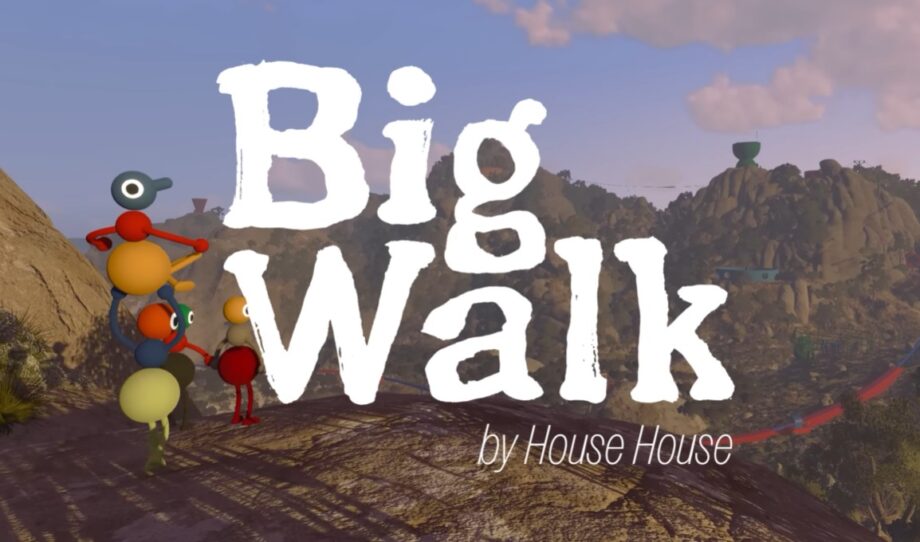
Big Walk makes an interesting companion for that idea. Developed by the creators of Untitled Goose Game and published by Panic, it builds its adventure around exploration, cooperation, and communication. Between two and twelve players can venture through its open world, encountering puzzles while deciding together where to wander next.
Its voice system gives those conversations a physical presence. Friends become harder to hear across distance, voices echo through corridors, and walls muffle speech. When talking cannot solve a problem, pointing and waving become part of the group’s vocabulary. Tools including walkie-talkies and binoculars encourage players to observe and coordinate.
That design suggests a different measure of immersion. A convincing world does not always need to overwhelm the senses; sometimes it simply needs another person who notices your absence. Waiting for someone, interpreting an enthusiastic gesture, or discovering that everyone has misunderstood the plan can make an ordinary session feel personal.
There is also something appealing about a game that leaves room for an unproductive detour. Big Walk explicitly welcomes quieter moments, including watching a sunset together. For groups accustomed to scheduling every match around objectives and progression, that freedom offers a reason to keep playing after the immediate puzzle is solved.
The hardware experience still has practical limits. Robertson’s account included occasional headset adjustments, and he reported difficulty getting Discord running. Big Walk’s integrated proximity chat helped that particular gathering work. Those observations describe one tester’s session, however, and should not be mistaken for comprehensive performance or compatibility testing.
What makes the story resonate is the possibility of keeping a shared appointment. Gaming friendships often depend on a narrow overlap between work, travel, family commitments, and free evenings. A device that lets someone show up can matter more in that moment than a sharper shadow or another graphics setting.
Big Walk gives that attendance somewhere inviting to lead. Its combination of shared discovery and playful communication makes the journey itself worth discussing afterward. One evening cannot settle the future of portable gaming, but it can illustrate its best promise: fewer missed gatherings, more spontaneous adventures, and another chance to get lost together with friends.