


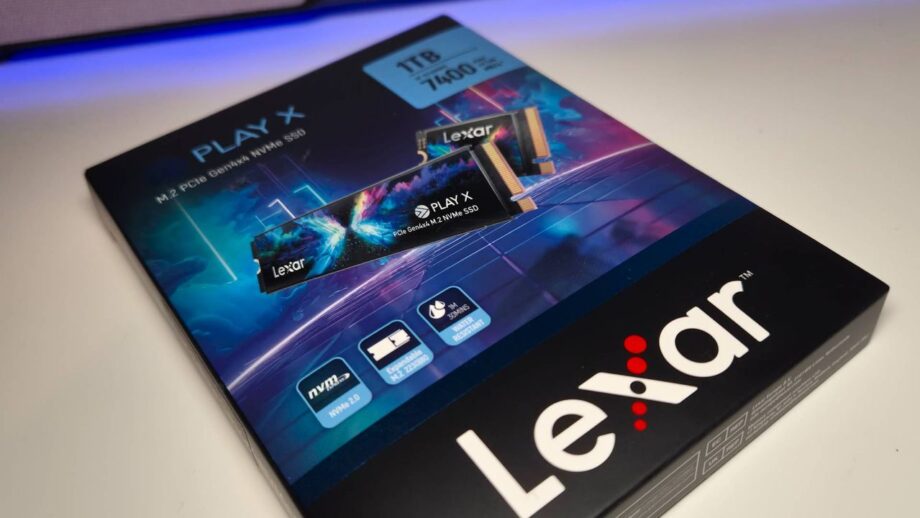
Even amid the RAM storage turmoil, new SSDs keep dropping, and Lexar’s Play hybrid drive offers both 2230 and 2280 compatibility in one package.
Design
(Image credit: Future/Rosalie Newcombe)
The Lexar Play combines a 2230 drive with a 2280 adapter, giving you flexibility to use it in laptops, handhelds, or desktops that only support the larger form factor. This design choice makes the drive more universally compatible than typical 2230‑only products.
Characteristics
(Image credit: Future/Rosalie Newcombe)
Provided as a 1 TB unit, the drive offers 952 GB of usable space after formatting. It uses TLC NAND and claims sequential read/write speeds of 7,400 MB/s and 6,500 MB/s, a noticeable jump over the older Play 2230 model’s 5,500 / 4,700 MB/s. A five‑year warranty and a 1200 TBW endurance rating (for the 2 TB version) round out the specs, while two holographic stickers are included for labeling.
Performance
(Image credit: Future/Rosalie Newcombe)
CrystalDiskMark tests recorded average read and write speeds of 7,074 MB/s and 6,551 MB/s, closely matching the advertised figures and even edging slightly ahead on write performance. In real‑world gaming, titles such as Counter‑Strike 2, Marvel Rivals and Dispatch loaded in 25.6 seconds, 41.2 seconds and 16.4 seconds respectively — only a few seconds slower than the built‑in PNY CS1030 drive, and well within a comfortable range for everyday play.
Should you buy the Lexar Play X 1TB SSD?
(Image credit: Future/Rosalie Newcombe)
Priced at £241.99 on Amazon, the drive sits above many mainstream 1 TB SSDs, but its hybrid form factor and strong speeds justify the cost if you need both 2230 and 2280 support. For pure 2280 performance, the Samsung 990 Pro (often under £200) remains a solid alternative, while older 2230 models can’t match the Play X’s capabilities. Overall, it’s a viable choice for users who value flexibility and speed over the absolute lowest price.
How I tested the Lexar Play X 1TB SSD
(Image credit: Future/Rosalie Newcombe)
I installed the drive, formatted it as a standard Gen 4 SSD, and ran four CrystalDiskMark tests to obtain average speeds. I also timed load times for several Steam titles, comparing them with my system’s existing storage. The results showed consistent performance that aligns with the manufacturer’s claims, confirming the drive’s suitability for gaming and content‑creation workloads.